.jpg)

Best Multi-Currency Account for Ghanaian Remote Professionals

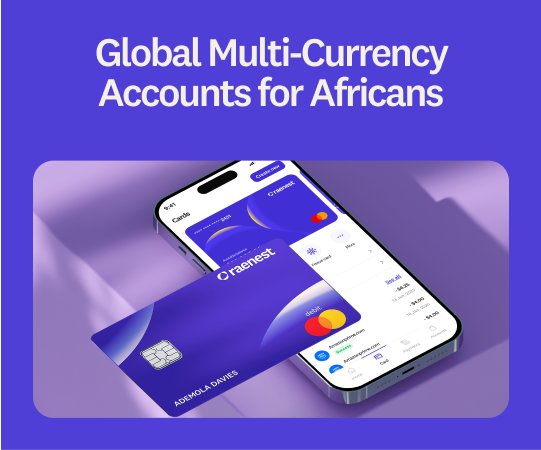
More Ghanaians are working remotely for clients abroad than ever, earning in dollars, pounds, and euros rather than cedis. A regular local bank account isn't set up to receive foreign currency cheaply, so more remote workers are choosing multi-currency accounts to avoid the high fees and poor exchange rates that come with getting paid from abroad.
This guide covers what a multi-currency account is, compares the top multi-currency accounts available to remote workers in Ghana and shows you how to set one up.
What is a multi-currency account?
A multi-currency account lets you receive and hold money in multiple currencies, such as dollars, pounds, and euros, in a single account. Instead of your bank converting every incoming payment to cedis at whatever rate applies that day, you keep the foreign currency until you're ready, then convert to cedis and withdraw to your local bank when the rate suits you.
For remote workers in Ghana, this solves the main problem with getting paid from abroad. Now that we know what it is, let's look at how to pick one.
🔗Starting a freelancing career in Ghana? You need to check out our blog.
What to look for in a multi-currency account
One of the most important decisions you'll make as a freelancer is how to receive your money, so it helps to know what a good multi-currency account should offer:
- Low fees and fair FX. Perhaps the most important thing: a good multi-currency account should help you save as much money as possible on deposit and currency conversion fees.
- Local account details. The best accounts give you account details in dollars, pounds, and euros, so clients and platforms pay you like a local instead of routing money across borders.
- Fast access to your money. Your earnings should reach your Ghanaian bank account in hours rather than days, and you should get quick marketplace payouts when you work through platforms, so check that any account you pick supports that.
- Easy setup from Ghana. You want an account you can open with your Ghana Card, without the lengthy approval process and heavy paperwork that traditional banks require.
- Round-the-clock support. Good providers offer 24/7 support, so a payment problem at an awkward hour doesn't leave you stuck.
- Built for remote work. A strong multi-currency account offers the features a remote career needs, including automated invoicing and a virtual card, as well as support for direct client payments and marketplaces like Upwork and Fiverr.
Once you weigh any account against these, only a few stand out for remote workers in Ghana.
Popular multi-currency accounts for remote workers in Ghana: Raenest Vs Grey Vs Payoneer
There are several accounts that remote professionals in Ghana use to receive money from abroad. Here's how the most popular ones compare.
Raenest
A Raenest multi-currency account is designed for professionals worldwide, and it works especially well for freelancers and remote workers in Ghana who are paid by clients abroad. Beyond just receiving payments, Raenest gives you a full ecosystem to run your freelance business from: multiple currency accounts (USD, GBP, EUR) under one login, a USD virtual card for ad spend and subscriptions, built-in invoicing so you can bill clients directly without a separate tool, and a flat fee structure that stays predictable no matter how much you're paid.
Raenest is also offering one free deposit until Aug 31st, plus monthly rewards. When you're ready to convert to cedis, Raenest charges a 0.7% currency conversion fee, capped at $7. So converting $1,000 to GHS costs $7, not $10, and the fee stops climbing no matter how much more you convert.
Moving that converted GHS to a local Ghanaian bank account or a Mobile Money wallet costs a flat $1, whether you're paying out to a bank account or straight to MoMo. You can learn more about how Ghanaian professionals use Raenest here.
Pros: local USD, GBP, and EUR account details, flat $2 ACH deposit fee for Ghanians regardless of amount, conversion fees capped at $7, flat $1 payout to bank or MoMo, fast Upwork payouts via FastTrack, invoicing and virtual card built into the same account, no monthly account fees.
Cons: If you frequently receive micro-deposits, the minimum fee structure might make small transfers more expensive than you'd expect.
Grey
Another popular option is Grey, which offers multi-currency accounts and a card for online spending across several African countries. Its ACH deposit fee is 0.8% of each incoming dollar transfer, with minimum and maximum caps, so what you pay changes with the size of the payment rather than staying flat.
When converting currencies on Grey, such as USD to GHS, you'll pay a 1% conversion fee, capped at $6 per transaction for conversions of USD, GBP, or EUR. Withdrawing to Mobile Money costs $0.20, while withdrawing to a bank account costs $1.20.
Pros: a multi-currency account and spending card in one app, trusted across several African countries, and no monthly account fees.
Cons: No specialised support for marketplaces like Upwork. No free deposits, and the percentage-based deposit fee means larger payments cost you more, and the conversion fees and withdrawal fees are higher.
Payoneer
If your work runs mostly through marketplaces, Payoneer is another long-established option, with US account details that many platforms recognise. Its ACH receiving fee is around 1% of each payment, and currency conversion fees can run as high as 3.5%, so, like Grey, the cost grows with both the size and the currency of the payment you receive.
Pros: widely recognised by major marketplaces like Upwork and Fiverr.
Cons: the roughly 1% ACH receiving fee adds up on larger payments, and conversion fees of up to 3.5% eat further into what you keep.
🔗Want to know more? Here’s an in-depth comparison of Raenest Vs Payoneer.
Why Raenest is the best multi-currency account for Ghanaian remote professionals
Say your work looks like most remote careers in Ghana, with payments arriving from different countries and currencies. What you want is one account that receives it all and lets you decide when to convert it to cedis, without a fee or a poor rate taking a cut every time. Raenest is built for exactly that.
With a Raenest account, freelancers in Ghana can:
- Receive payments in USD, GBP, or EUR from clients and platforms worldwide.
- Get Upwork payouts in under an hour, even at weekends, with Raenest FastTrack.
- Receive USDC and USDT, converted to USD at a one-to-one value.
- Get paid via ACH with a $1 flat fee, regardless of the amount.
- Receive salaries and client payments from more than 160 countries.
- Create professional invoices for one-off and recurring payments with Raenest.
- Convert to cedis at competitive rates and withdraw to your local bank.
- Send and receive money across more than 160 countries.
- Spend with USD virtual cards to pay for ads and subscriptions from Ghana.
This combination is what makes Raenest the best multi-currency account for Ghanaian remote professionals.
Open your free Raenest account today and keep more of every international payment you receive.
Frequently asked questions
- How do I get paid in USD as a remote worker in Ghana?
You open a USD account that provides you with US account details, like Raenest, so clients and platforms pay you as though you were local. From there, you convert to cedis at a rate that suits you and withdraw the funds to your Ghanaian bank account.
- Can I open a multi-currency account in Ghana without going to the bank?
Yes. Providers like Raenest let you open dollar, pound, and euro accounts from Ghana using your Ghana Card.
- What's the cheapest way to receive international payments in Ghana?
It depends on how you get paid and how much. Flat-fee providers like Raenest are cheaper for larger payments, since you pay $2 per ACH transfer regardless of the amount in Ghana, while percentage-based providers like Grey or Payoneer cost more as the payment size grows. If you receive frequent, sizeable payments, a flat-fee account saves you the most over time.
- How long does it take to receive payments with a multi-currency account in Ghana?
With Raenest, ACH transfers typically arrive within a few days, and Upwork payouts through FastTrack can land in under an hour, even on weekends. This is much faster than traditional banks, which can take several business days to process incoming foreign currency payments.
.jpg)

