The Ghanaian Freelancer Starter Pack: Everything You Need to Start Freelancing in Ghana

In homes and cafes across Ghana, a different kind of workday is taking shape. Someone wraps up a call with a startup in Berlin before lunch, while across town, another sends a finished design to a client in Toronto and gets paid in dollars. It doesn't always look like a traditional job, but it's fast becoming one of the most reliable ways to earn in Ghana.
The World Bank has found that demand for online gig work across developing countries has climbed by more than 130 per cent in recent years, with Sub-Saharan Africa among the fastest-growing regions. In Ghana alone, the Oxford Internet Institute's Fairwork research estimates that somewhere between 38,000 and 258,000 people are already active in the gig and freelance economy. So this isn't a leap into the unknown. It's a movement that's already well underway, and there's room for you in it.
This guide explains how to start freelancing in Ghana, from choosing what you offer and finding clients to getting paid by clients abroad without losing a chunk of your earnings.
What is freelancing?
Before you start, it helps to be clear on what freelancing actually is. Freelancing means working for yourself and selling your skills to clients on a project- or contract-based basis, rather than holding a single salaried job with a single employer. You pick your own clients and rates, and you decide how much work to take on at a time, from one steady client to several at once.
It covers a wide range of work. A freelancer might write, design, code, edit videos, run social media, or handle admin for businesses anywhere in the world. What ties it together is that you're paid for the work you deliver rather than for the hours you clock in an office, and you can do it all from a laptop in Accra or anywhere with a decent connection.
That's why freelancing rewards people who can actually solve a problem. The skills in steady demand from Ghana right now include web development, graphic design, content writing, digital marketing, video editing, and virtual assistance, and none of them requires a degree, only proof that you can deliver.
The pay is worth the effort because you're earning in foreign currency. A virtual assistant might charge somewhere between $8 and $20 an hour, a developer or designer a good deal more, and even a few hundred dollars a month goes a long way once it's converted to cedis. For many people, a modest income in dollars can outperform a full-time local salary.
It rarely happens overnight, though. The freelancers who are doing well are the ones who kept showing up after the first handful of proposals went nowhere, so treat the slow start as part of the process rather than a sign that it isn't working. Once you understand what freelancing is, the next step is setting yourself up to do it properly.
How to start freelancing as a Ghanaian
Getting started comes down to a few clear decisions. Take them in order, and you save yourself a lot of guesswork later.
Start with what you'll sell: Pick a skill you already have or can learn well enough to charge for, then get specific about it. A vague "I'm a writer" or "I do design" gets lost among thousands of others, while something like "I write email campaigns for e-commerce brands" or "I design pitch decks for startups" makes you the obvious choice for one particular job. You don't have to guess your niche either. Spend an hour reading recent briefs on the marketplaces and notice what clients keep asking for and where they sound frustrated, because that frustration is your opening.
Next, decide what to charge: As a beginner, it's tempting to price low to win work, and a slightly lower rate can help you land those first reviews, but don't go so low that the work isn't worth your time. Look at what others in your niche charge, start with a reasonable rate, and raise your rates as your portfolio and reviews grow.
Then choose where to offer it, because the platform shapes the clients you meet:
- Upwork is the largest marketplace and works for almost every field, from development to writing, if you're ready to bid on international contracts. Our guide on how to get started on Upwork walks you through the setup.
- Fiverr lets you list packaged services and wait for buyers to come to you, which makes it one of the friendlier places to start as a Ghanaian freelancer.
- Contra is commission-free, so you keep your full rate, and it leans towards creatives and portfolio-led work. Here's how to get clients on Contra.
- Toptal is invite-only and built for experienced, top-tier professionals, with higher rates for those who pass its screening.
Land your first clients
The first few clients are the hardest to win, so treat finding them as a daily habit rather than something you do when the mood strikes. Nobody wants to be the first to trust an empty profile, so your first job is to make clients trust you. A few things help:
- Seed some proof. Do one or two small jobs at a lower rate, or help a business you already know, in exchange for an honest review and a portfolio piece. A local shop's Instagram redesign counts as much as an international gig when you're starting out, and even a self-made sample gives clients something concrete to judge.
- Make your profile sell. Lead with a specific title and open with the result you deliver rather than a list of tools. Put your best two or three samples where a client sees them first.
- Send proposals and pitches that speak to the client. Skip the copy-paste, read the brief, and in your first two lines show you understood their exact problem and how you'd tackle it, then suggest a clear next step. A short, sharp proposal beats a long one about you.
- Show up consistently. Pick a number, say ten proposals or messages a day, and hit it, because volume plus patience is what fills a pipeline when you're still unknown.
- Use the network you already have. Let past employers and local business owners know you're freelancing and what you offer, since a referral from someone who knows you skips the trust barrier completely. On LinkedIn, message founders with a specific idea rather than a vague hello.
- Turn first jobs into more work. Overdeliver and hit the deadline, then ask the happy client for a review and a referral. A few glowing reviews and a repeat client or two are often all it takes to stop chasing work and start choosing it.
🔗If you'd like a proper head start, we've put together a freelancer toolkit with pretty much everything you need to build a successful freelance career.
Register with the Ghana Revenue Authority
Once you have clients and money coming in, it's time to make your freelancing official. Handling it early saves you trouble later. In Ghana, freelancers are considered self-employed, which means they must register with the Ghana Revenue Authority (GRA) and obtain a Taxpayer Identification Number, now issued through their Ghana Card. If you're earning more than about GHS 500 a month, it's worth registering your activity as a sole proprietorship with the Registrar General's Department as well, since that makes invoicing and banking cleaner.
On the tax itself, Ghana runs a progressive personal income tax, so the first slice of your income is tax-free, and the rate climbs as you earn more. You file an annual return by 30 April for the previous year, and as a self-employed person, you're expected to make quarterly advance payments throughout the year rather than one lump sum at the end. SSNIT contributions are optional for the self-employed, though many freelancers pay into it to build towards a pension.
Bands and rates change, so check the current figures with the GRA or a qualified accountant before you file, and take this as general guidance rather than tax advice. One habit saves you every filing season: move a portion of every payment into a separate pot the moment it lands, so the bill is never a shock. That leaves one last piece, and it matters most: making sure those payments actually reach you in full.
Get Paid Easily as a Ghanaian Freelancer
Your clients and platforms mostly pay in US dollars, and the usual routes take a heavy cut. Wire transfers carry steep fees and slow timing; some payout services charge you to receive and again to convert, and a weak exchange rate can cost you more than any single fee.
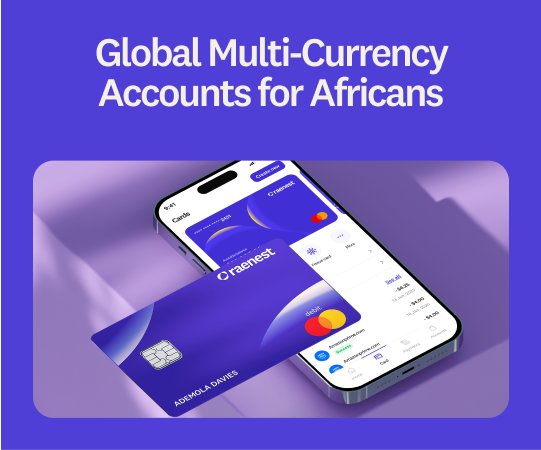
A multi-currency account built for cross-border work is what smooths all of this out, and that's what Raenest is for. You get dedicated account details in USD, GBP, and EUR, so clients and platforms pay you as if you were local, and your money lands in dollars for a low, flat fee. From there, you can either hold it or convert it to Ghana cedis at a competitive rate and withdraw it from your local bank.
With a Raenest account, freelancers in Ghana can:
- Receive payments in USD, GBP, or EUR from clients and platforms worldwide.
- Get Upwork payouts in under an hour, even at weekends, with Raenest FastTrack.
- Receive USDC and USDT, converted to USD at a one-to-one value.
- Create professional invoices for one-off and recurring payments with Raenest.
- Convert to cedis at competitive rates and withdraw to your local bank.
- Send and receive money across more than 160 countries.
- Spend with USD virtual cards that work in global stores and support Tap to Pay.
Final Thoughts
The clients are out there, the skills are yours, and the only thing left is to set things up properly from day one. Ignore the "get a real job" chorus, sort the money side early, and keep every cedi you earn.
Create your free Raenest account today and get paid quickly, wherever your clients are.
Frequently asked questions
Do I need to register with the GRA to freelance in Ghana?
Yes. Freelancers are treated as self-employed, so you register with the Ghana Revenue Authority and get a Taxpayer Identification Number through your Ghana Card, then file a return each year.
How much can I earn as a freelancer in Ghana?
It depends on your skill and experience. Rates often start around $8 to $20 an hour for support roles and rise well beyond that for developers, designers, and specialists.
What's the best way to get paid as a freelancer in Ghana?
Most clients and platforms pay in US dollars, so a multi-currency account like Raenest is usually the best option. You receive in USD, GBP, or EUR, hold or convert to cedis at competitive rates, and withdraw to your local bank.
Do I pay tax on freelance income in Ghana?
Yes. Freelance earnings count as income, so register with the GRA, file by 30 April, and make the quarterly advance payments expected of self-employed people.