Raenest Diaries: How Visibility Took Ore Badmus from Teaching to a Global Talent Visa

There’s this undeniable feeling you get when you know you want more than the life you have right now. Maybe you have chased it before, more than once, and watched it slip. Or maybe you don't even know how to go about it. But you know you have what it takes. You've done some work, but just need someone to pay attention.
Ore Badmus knows that feeling. A few years ago, she was an early years drama teacher taking home about 92,000 naira a month, with no clear route to anything bigger. Today, she is a Senior Product Marketing Manager in London on the UK Global Talent Visa. This is why we are thrilled to have her for this episode of Raenest Diaries.
Today’s session is less about the arrival photo and more about the journey. How do you position yourself as someone the world takes seriously when you are starting from nowhere? What actually counts as proof? And what do the finances really look like once you make the move?
We asked Ore to walk us through it.
Temi: Hello Ore, First things first. Who are you and what do you do?
Ore: My name is Ore Badmus. I am a Senior Global Product Marketing Manager and Creative Director, and I run my own jewellery business on the side, Karata Studio. I co-founded the non-profit TEMSI Africa with Izzie Ekong to put African tech marketers on the map. We give them scholarships and access to mentors who can accelerate their careers, so they don't start clueless or learn everything the hard way.
I am based in London now, working in creative tech. On my Instagram page, @shesthatsunchild, I document my lessons and my journey towards building a better life than the one I grew up with. A big part of that has been using my career and my visibility to give myself the quality of life I always felt I deserved.
Temi: Can you describe yourself in a sentence?
Ore: "Impossible to ignore." And that is not by luck. It is because I have always put out the best-quality work I can and stayed visible while doing so. When I look back, it all comes down to those two things.
Temi: So was tech always the plan?
Ore: Not even slightly.
I am a millennial. I graduated in 2012, and back then, there wasn't much awareness of tech in Nigeria. It was all brick-and-mortar businesses and FMCG brands. All I knew was that I wanted to create. So I did a lot of acting and filmmaking, then I taught for 5 years.
By my fifth year, I was itching to leave, but I did not know what I would do next. That was around 2018 and 2019, when tech was finally having its moment in Nigeria. I thought product management might be something I could move into, but I was not sure.
Then a friend tagged me under a tweet from the CEO of uLesson, who was looking for a creative lead. My friend knew my classroom work and my creative background, and he figured I had transferable skills. The CEO slid into my DMs, we set up an interview, and it turned out there was a real fit. They basically needed me to do what I was already doing in the classroom, but digitally.
Honestly, I was reluctant at first. I felt like I was giving up my theatre dreams. But friends talked sense into me. Your journey does not have to be a straight line. It can bend and change shape and still take you somewhere good.
Temi: You keep coming back to visibility. Why?
Ore: Because when you are building from nothing, nobody hands you anything. You work with what you have, and what I had was the ability to talk about what I was doing. So on Twitter and LinkedIn, I kept talking about my work, even the classroom job I was not always thrilled to show up for. I had pinned a tweet about a musical I directed and produced at my school that sold out two full shows, and that was the post the uLesson CEO saw. That one pinned tweet is a big part of how any of this happened.
Temi: And the offer itself was a moment, wasn't it?
Ore: (laughs) It was six times my salary. My take-home as a teacher was about 92,000 naira. ULesson offered me around 600,000.
I actually got the offer letter at a club. It was my friend's birthday, and we were doing karaoke. I saw the email, went to the restroom, knelt, and started praising God. Someone walked in, saw me on the floor, and asked if I was okay. She thought I was tipsy. I said, “No, I just got a job”—best moment of my life at the time. Then I relocated to Abuja, and that was where my tech journey properly began.
(We both crack up at this point.)
Temi: When did the Global Talent Visa first cross your mind?
Once I was in tech, I made networking my business because I was coming in from the outside and didn't know much. I also took courses at Trefford on product marketing and eventually became a mentor there. That opened my eyes to what was possible.
Somewhere in there, I heard about the global talent endorsement. I did my research, spoke to people, and realised it was something I could work towards. In my early years, it was not the focus. It was more of a distant pinnacle, the thing at the top of the mountain to aim for. I was not even confident I would get it. What kept me moving was staying visible and documenting my work as I went from startup to startup.
Temi: And you got it in about four years.
Ore: Yes, but I would say it is less about the number of years and more about their quality.
I am a workaholic. I used to feel bad about that, but I own it now. Owning it meant I was always putting my hand up for the hard campaigns and asking to lead things. I was also strategic about which startups I joined. So by the time I was ready to apply, those few years were dense with real work.
Funny enough, I did not think I had enough evidence. It was people watching from the outside, some of them people I did not even know, who reminded me. They would say, “Remember that metric you shared, that campaign you led, the time your boss posted your growth chart.” That sent me back to the drawing board, and I realised there was actually a lot to work with.
Temi: What was it actually like putting the application together?
Ore: One of the hardest things I have ever done.
I am not an application person. Most of my roles came through referrals, from people who had seen me do good work, so I had barely job-hunted before. I applied to 136 jobs before I got a single yes, but I took every rejection as an opportunity to refine my approach and strengthen my applications. Pulling the evidence together was also tedious.
I gathered proof of the impact I had made: manager accolades, screenshots of people commending me in the office group chat, and feedback on things I had led. I collected evidence that I was actually on the ground at company initiatives, so I could show I really did lead what I claimed to. I pulled the metrics, including the baseline and the result, so that you could see the full trajectory.
Then there were letters from industry leaders who had worked with me or knew my work and could speak to my credibility. And finally, but equally as important, evidence of my impact beyond my day job. The mentoring, the community work, the times I spoke at events. All of it counted.
🔗ICYMI: Our full Global Talent Visa guide lays out the timelines, the evidence you actually need, and what the whole thing costs, much of what Ore describes here, gathered in one place. Read the full guide here.
Okay, back to the interview.
Temi: Before the move, did you ever doubt it was the right decision?
Ore: No, and I mean before I even got the endorsement.
I was burnt out. I had peaked in my role, and there was nowhere left to move, not within the company and not really within another Nigerian or African startup either. I was done. It was risky because I was putting all my eggs in one basket, but I knew it was right. And everything that has happened since has only reinforced that.
Temi: When you finally got the successful application, what were you most anxious about?
Ore: My accent, first of all. I somehow felt I would have to change how I spoke to fit in. I asked a friend who ran my mock interviews whether I needed to turn it up or down, and he said, " You are fine, people can hear you clearly, that is all that matters.”
Back home, I had presented to leadership and pitched to investors, and I worried that being a Black woman from Nigeria with a non-British accent would stop me from doing that here.
Second was visibility. My personal brand had opened every door for me at home. Here, nobody knew me. I was starting from scratch, which is exactly what I have been doing since. But I assured myself that a different climate wasn’t going to make me less excellent.
Third was the culture. I can be very expressive, so I worried I would have to shrink myself. In the end, I decided to keep as much of my identity as I could and only tweak what genuinely needed tweaking. How I dress, how I speak, all of that. It is actually part of what got me noticed quickly at work, as the only Black person on my team and in the whole company.
Temi: Let's talk finances. Setting up your money from scratch in a new country, how was that?
Ore: One of my biggest challenges was that I did not understand the value of money here. Down to standing in a shop, wondering how much is too much for a doughnut. Or a pack of cookies. The whole system felt foreign. Even how to pay for things when I arrived.
The credit system threw me too. In Nigeria, I saw credit as purely a bad thing. People would say you can take a loan and put a down payment on a car, and my answer was, “God forbid.” I had to learn that there is such a thing as good credit here, and that it can help you build towards your goals rather than sink you.
Then there was working out my own worth. Which offers were lowballing me, and which were fair for a newbie in this country? Every time I got an offer, I ran it past friends who were already here.
Accommodation came down to network again, and I cannot stress this enough. Some of the people who helped me were not close friends. They were people I admired from afar. The moment I got endorsed, I sent them DMs. From there, I could ask them anything. Where should I live near my office? What is a fair price for a shared flat? What does living alone cost? Different people gave me different numbers, and slowly, I had a picture of where to start. I was never afraid to look like a novice, because you do not know what you do not know.
BTW: We have a detailed blog post on the cost of living in the UK. Another thing Ore's story makes clear is how much money moves before you even land. Flights. A deposit on a flat. Those first few days of spending in a country where you know nobody. And opening a UK high-street bank account isn't the quick job people assume it is, so you often end up paying for things before a local account even exists.
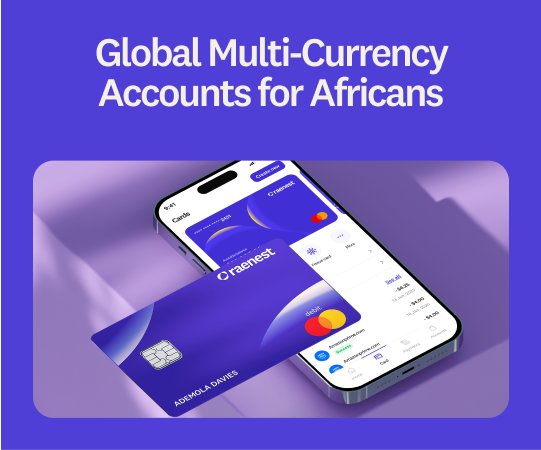
That is the gap a Raenest account fills. You can hold and spend USD, GBP and EUR from the start, cover your flights and accommodation up front, and move your own money across before any high street bank has finished approving you. Open a Raenest account here.
Temi: So, for someone new to tech who wants to apply one day, what should they focus on?
Ore: Impact, first and always.
At work, make sure most of your energy goes into the things that move the needle, the work that puts you in front of your manager, your peers and their managers. Once you have that, document every part of the journey. Keep a brag folder. Screenshot everything. Nothing is too small, because you never know what you will need at the point of application.
But do not stop at the day job. A lot of the people who come to me now have a strong work record, but almost nothing for the wider ecosystem. So give back too, whether that is mentoring, sharing what you know, or teaching where you can. And talk about your work as you go. If you are worried about company secrets, find a creative way to talk about your own slice of the bigger picture. That way, when you need letters and recommendations years later, the people writing them have been watching your evidence pile up the whole time.
Temi: Last one. What would you tell yourself ten years ago?
Ore: I would tell her not to get too stuck on how she reaches her vision, this step, then that step, then the next. Life happens in unexpected places and tends to land you where you always wanted to be anyway.
I would tell her to be brave. Her conviction is stronger than she thinks, so she should believe it and take the courageous step.
And I would remind her that she has always known who she is. She should not let naysayers or doubt get into her head and change that, because it is exactly what makes her impossible to ignore.
Final thoughts
Ore's story proves the route is doable with the right strategy and preparation. It is also proof that it is nowhere near the frictionless montage the arrival photos suggest. There is a lot of positioning and networking involved. And if Ore’s personal story is anything to go by, at least one moment of gratitude on a club bathroom floor.
That brings us to the end of today’s discussion. I hope you learned something new.
See you in the next diary session.
.jpg)
.jpg)