

Domiciliary Account vs Multi-Currency Account: Which Is Better for Holding USD in Nigeria?

If you earn dollars as a Nigerian remote worker, freelancer, or contractor, where you keep your money is almost as important as how much you make. The wrong account can lead to unfavourable exchange rates, transfer limits, hidden fees, or make it harder to use your money when you need it, whether that's for global payments, protecting against naira depreciation, or investing.
For years, domiciliary accounts were seen as the default option for holding foreign currency in Nigeria. For many people, they still are. But newer multi-currency accounts have created another option, one built with digital payments, flexibility and remote workers in mind.
So, which option is better for holding your USD earnings?
In this guide, we compare domiciliary and multi-currency accounts, how they work, where each performs best, and which may be better suited to Nigerian global earners today.
What Is a Domiciliary Account?
A domiciliary account is a bank account that allows you to receive, hold and transact in foreign currencies such as US dollars, pounds sterling or euros through a traditional bank.
Historically, these accounts have been the go-to option for Nigerians who receive international payments, collect remittances, or need to make foreign transactions.
With a domiciliary account, you can typically:
- Receive foreign wire transfers
- Hold funds in dollars instead of converting to naira
- Send international payments
- Withdraw in foreign currency, subject to your bank’s terms
If you like traditional banking, this type of account can feel familiar and safe. However, it often comes with some downsides. Opening and maintaining a domiciliary account can require extensive paperwork, branch visits, and compliance checks. Sometimes, there are also limits that make remote work less flexible.
This is where multi-currency accounts like Raenest are starting to change things.
What Is a Multi-Currency Account?
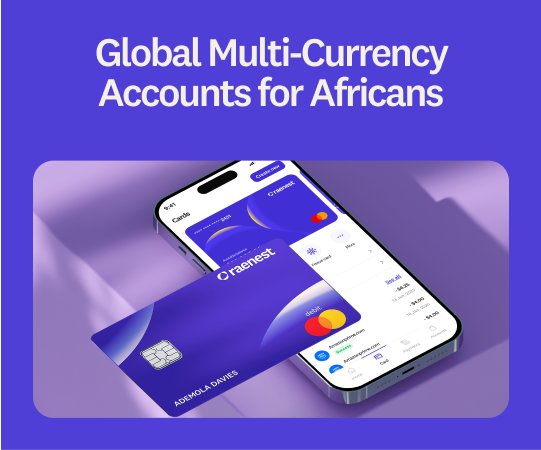
A multi-currency account lets you hold, receive, send, and sometimes spend in different currencies from one account, usually through a digital platform.
Instead of just storing foreign currency, many multi-currency accounts like Raenest help you manage your global income more actively.
Multicurrency accounts like Raenest typically offer:
- Virtual USD, GBP and EUR receiving accounts
- International transfers
- Currency conversion
- Global spending options and virtual cards
- Access to savings or investing features
For remote workers, this means you can handle all your earnings in one place, making it easy to get paid, manage your money, and even grow your funds.
Both account types help you keep money in dollars, but the real difference lies in how they work day to day.
Domiciliary Account vs Multi-Currency Account: Key Differences
Account Opening Requirements
This is usually the first big difference. Traditional domiciliary accounts often need more checks, paperwork, and sometimes branch visits before you can use the account. Banks may also ask for references, a minimum opening balance, and extra documents. Multi-currency accounts are usually simpler to open. You still need to verify your identity with utility bills, valid IDs, and proof of income, but the process is mostly online and much faster.
Account Limits
Account limits are another area where the differences really show. Domiciliary accounts can come with relatively restrictive transfer or usage limits, ranging from around $1,000 weekly, depending on the bank, channel, or transaction type. For someone paying tuition abroad, supporting family internationally, funding investments, or managing large client payments, that can feel limiting very quickly.
For remote workers whose income changes each month, higher limits are not just nice to have; they are often necessary. This is where multi-currency accounts can really help.
With Raenest, users can access higher daily inflow limits based on account verification tiers:
- Tier 1 to 4: Up to $10,000 daily
- Tier 5: Up to $20,000 daily
- Tier 6: Up to $50,000 daily
- Tier 7: Up to $150,000 daily
For high-earning freelancers, consultants, and remote teams, these higher limits make it easier to grow your business without hassle.
Receiving USD Payments
Both account types can receive dollar payments, but the experience can differ. Traditional domiciliary accounts mostly use regular wire transfers, which work, but can feel limiting if you get paid through different channels.
Multi-currency accounts usually give you more options. With Raenest, for example, you can get paid through ACH, automated invoicing, domestic wire transfers, SWIFT, and even stablecoins like USDC and USDT, which are instantly converted to USD. For many global earners, this flexibility is just as important as the account itself, because getting paid matters easily. Don’t have a Raenest account? Create one today.
🔗ICYMI: We wrote a free guide on how the US Banking system works!
Exchange Rates and Conversion Costs
Holding dollars is just one part of the story. How and when you convert your dollars can make a big difference in how much money you keep.
With some traditional banks, conversion fees and transfer charges can slowly eat into your earnings. It might not seem like much at first, but over time, these costs add up. Accounts are often built to reduce that friction. With Raenest, conversions incur low fees of $0.25 to $2.70, while naira withdrawals incur no fees. Over time, that kind of cost efficiency can make a meaningful difference.
Wealth-Building and Investment
This is where the comparison goes beyond just banking. A traditional domiciliary account mainly holds your money, but multi-currency accounts like Raenest help you do more with it. That includes global payments infrastructure, access to USD, GBP and EUR accounts, automated invoicing, low-cost conversions, bill payments, and investment in over 4000 U.S. Stocks and ETFs to grow your wealth.
🔗New to investing? Here’s how to invest in U.S stocks and ETFs from Nigeria.
Final Thoughts
If you just want to store foreign currency in a traditional bank, a domiciliary account can work. But if you want to receive, manage, move, and grow your dollar earnings, a multi-currency account gives you much more flexibility.
For many Nigerian remote workers, this is becoming the main reason to choose one account over another. It's not just about where your money is kept, but what it can do for you. Your remote income can do more than pay bills—it can help you save and build wealth, but only if it's in the right account.
Want to start receiving USD payments easily? Sign up for Raenest today and get one free ACH or stablecoin deposit each month.
Frequently Asked Questions
What is the major difference between a domiciliary account and a multi-currency account?
A domiciliary account is typically designed to hold and transact in foreign currencies through a traditional bank. A multi-currency account can go further, allowing you to receive, hold, convert, send and sometimes invest from one platform.
What is the best way to receive USD payments in Nigeria?
That depends on how you work, but many freelancers and remote workers now prefer multi-currency accounts like Raenest to receive payments through ACH, domestic wire transfers, SWIFT and even stablecoins like USDC and USDT, which are instantly converted to USD.
Can I receive USD payments from international clients in Nigeria without a domiciliary account?
Yes, you can receive USD payments in Nigeria without a traditional domiciliary account by using a modern multi-currency account like Raenest. Multi-currency accounts allow you to receive payments via ACH, SWIFT, domestic wire, and even stablecoins, often with fewer restrictions and lower fees than traditional bank domiciliary accounts. This makes it easier for freelancers, remote workers, and businesses to get paid globally and manage their funds efficiently.
Which is safer for holding dollars in Nigeria: a domiciliary account or a multi-currency account?
Both domiciliary and multi-currency accounts are designed to hold foreign currencies, such as USD, safely. However, multi-currency accounts from reputable fintech providers like Raenest often include extra security measures such as two-factor authentication, instant notifications, and advanced digital controls. They also offer greater flexibility for managing, converting, and investing your funds, making them a secure and modern alternative for Nigerian professionals earning in dollars.
.jpg)

