.jpg)

A Brief History of Cross-Border Payments in Nigeria

Money has always moved before systems knew what to call it. In Nigeria, long before dashboards and instant confirmations, cross-border payments existed as an act of faith. Someone sends money from another country, and what followed was not certainty but waiting. An expected stretch of time where money hovered outside reach, somewhere between intention and access.
In this timeline, messages are sent, receipts are shared, and promises are suspended in transit. One knew the money existed because someone said so, because a reference number was written down, or because you got an email. Yet knowing and holding were very different states. And this vague space shaped how Nigerians planned, worried, and adjusted to life.
Over time, systems would improve, interfaces would modernise, and timelines would shorten. But the memory of that waiting stayed. It still does. To understand why cross-border payments matter so much today, and why Nigerians care deeply about how money moves, here’s a brief history of cross-border payments in Nigeria.
The Era of Forms and Lines
Before fintech platforms existed, receiving money from abroad was measured in hours and days, not seconds. In the 1980s and 1990s, Western Union and MoneyGram were the main channels. People waited at their counters, carrying slips of paper that felt heavier than the cash they represented. Bank transfers were possible, but slow, opaque, and mediated by correspondent banks in Europe and the United States. Each bank transaction required careful attention: names, account numbers, SWIFT codes, and confirmation calls. A single mistake could ripple across weeks.
By the late 1990s, the internet had begun to expand possibilities, but practical access remained limited. Early online payment systems—small credit card processors, E-gold, and niche platforms—existed, yet they were mostly inaccessible to Nigerians. Foreign accounts, credit facilities, and technical knowledge were often prerequisites. Even where these systems were technically usable, verification procedures, local withdrawal challenges, and hidden fees made them unreliable.
Then, the early 2000s brought PayPal. For many globally, it represented a shift. Freelancers, small businesses, and expatriates finally had a digital method to receive payments from clients abroad. By the mid-2000s, though still limited, Nigerians had begun to taste the possibilities of the digital world. Freelancers, small businesses, and expatriates could, at last, see their efforts reflected on screens. The world beyond Nigeria felt less abstract, more tangible, and the sense of possibility was addictive, sweet as sugar melting across a tongue long starved of convenience and control.
When Possibility Faltered
Sadly, PayPal in Nigeria had limitations. Nigerians could send payments, but withdrawing directly into Nigerian banks was not possible for years. Users had to rely on friends or relatives abroad, alternative accounts, and informal networks just to access their own funds.
And just as the uncomfortable comfort had begun to settle in, it was taken away. Restrictions crept in first as whispers: new verification steps, sudden freezes on accounts, warnings that funds might be held without explanation. Users learned that access could vanish in a single notification, that balances were fragile, that the system they had begun to trust was not theirs to command.
Over time, access to PayPal for Nigerian users became increasingly limited, as global compliance and infrastructure decisions narrowed what was possible locally. And finally, in 2004, PayPal withdrew key features entirely for Nigerian users, cutting off the pathways that had begun to make sense after months, even years, of work.
As expected, the impact reshaped how Nigerians approached global payments. People had begun to imagine a life where international payments felt predictable; suddenly, that imagined life recoiled. Freelancers who had planned around these digital channels scrambled. Businesses that had experimented with cross-border payments pivoted, recalculated, and improvised. Networks of friends and relatives, once informal support, became essential scaffolding again.
Within that ache of frustration, the shape of necessity began to emerge. If the first taste of possibility could vanish so suddenly, the question became unavoidable: Who would construct a bridge strong enough to bear the ambitions and labours of a generation that had waited too long for its worth to be recognised?
🔗In case you missed it, Raenest now has the best rates for receiving international payments in Nigeria. Learn more here.
Building the Bridge
The answer came through lived experience. Years of stalled transfers, frozen balances, and makeshift solutions had carved a gap that could no longer be ignored. For Victor Alade, the CEO and Co-founder of Raenest, that gap was personal. He had lived it—the delays, the uncertainty, the constant patchwork to keep things moving—and he knew that countless others were navigating the same frustrations. Those experiences planted a vision: a platform that could finally solve the issue of cross-border payments. Changing it from a gamble into something dependable, deliberate, and human-centred.
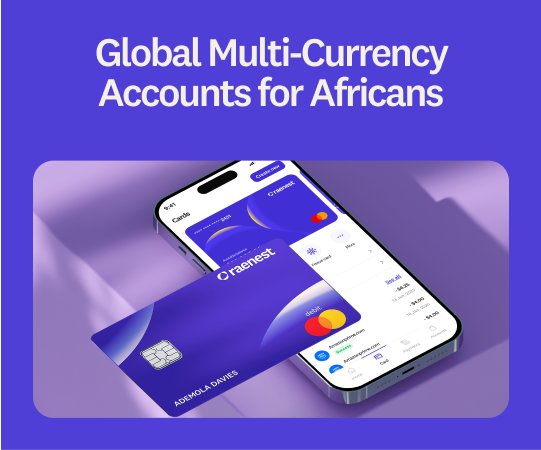
In 2022, that vision became Raenest. Born to connect global earners in emerging economies to the wider world, Raenest opened doors for Nigerians to engage with international finance with speed, clarity, and trust. Starting with multi-currency accounts in USD, GBP, and EUR, the platform was built for realities users had been living with for decades, realities that demanded more than promise; they demanded action. With Raenest, Nigerians can:
- Create multi-currency accounts: Open accounts in USD, GBP, and EUR to manage all your international payments in one place.
- Receive payments: Get salaries, freelance payments from platforms like Upwork and Fiverr, client transfers, payouts from global platforms, and even money from loved ones.
- Raenest FastTrack: Receive Upwork payments in less than an hour at any time and any day, including the weekends, at no extra cost with Raenest FastTrack.
- Stablecoins: Receive USDT and USDC, which are automatically converted to USD at one-to-one value with no delays.
- Smart Invoicing: Create professional invoices for one-time and recurring payments in minutes.
- Flexible conversions: Convert your funds to NGN anytime at competitive rates and withdraw to your local bank account.
- Global transfers: Send money worldwide efficiently and securely.
- Raenest dollar card: Create a virtual or physical USD card to pay for subscriptions, tools, ads, and online services.
- Invest in U.S. Stocks: Own a share of the world’s leading companies like Apple, Tesla, Google, Nvidia, Amazon, and more with as little as $2. Enjoy 1 commission-free stock purchase every month, plus AI-powered performance summaries to help you make smarter decisions.
- Pay bills at a discount: Buy airtime and data directly within the app at discounted rates, without switching between platforms or dealing with extra steps.
- Cost and speed advantages: Enjoy faster transfers, better rates, low fees, and four free monthly deposits.
Also read: Everything you need to know about starting your investment journey on Raenest.
For a generation shaped by years of careful effort and steady persistence, Raenest stood as a bridge shaped by the same patience, the same creativity, and the same enduring hope that had carried them this far.
Today, global platforms are once again evolving their presence in Nigeria. That shift reflects how much the market has grown and how important it is that systems are built with long-term access, trust, and local realities in mind.
.png)

