
Cost of Living in Canada in 2026: A Complete Monthly Budget Guide


You've had plans to move to Canada for a while now, or maybe you've already secured a visa and are about to head off into your next adventure. Whatever phase you're in, you're probably already considering the financial implications of life in Canada.
The country consistently ranks among the top destinations for its quality of life, strong job market, and natural landscapes. But moving abroad is about more than visa fees and flights. It’s the everyday costs that define how comfortable life actually feels once you get there.
The honest answer is that Canada is not a single flat-cost environment. Daily life in Toronto bears no resemblance to that in Montreal, Calgary, or a smaller regional city. How much you spend depends on where you settle, whether you rent alone or with flatmates, how much you drive, and whether you’re moving as a single professional, a couple, or a family with children.
This guide pulls together the latest 2026 data and multiple housing reports to give you a clear, city-by-city, category-by-category breakdown of what life in Canada actually costs right now.
Cost of Accommodation in Canada in 2026
Housing is the dominant expense for nearly everyone living in Canada, and where you choose to live will define your entire budget. The good news heading into 2026 is that rents have softened from their 2023 to 2024 peaks.
The not-so-good news is that major cities, particularly Toronto and Vancouver, remain extremely expensive by any global standard.
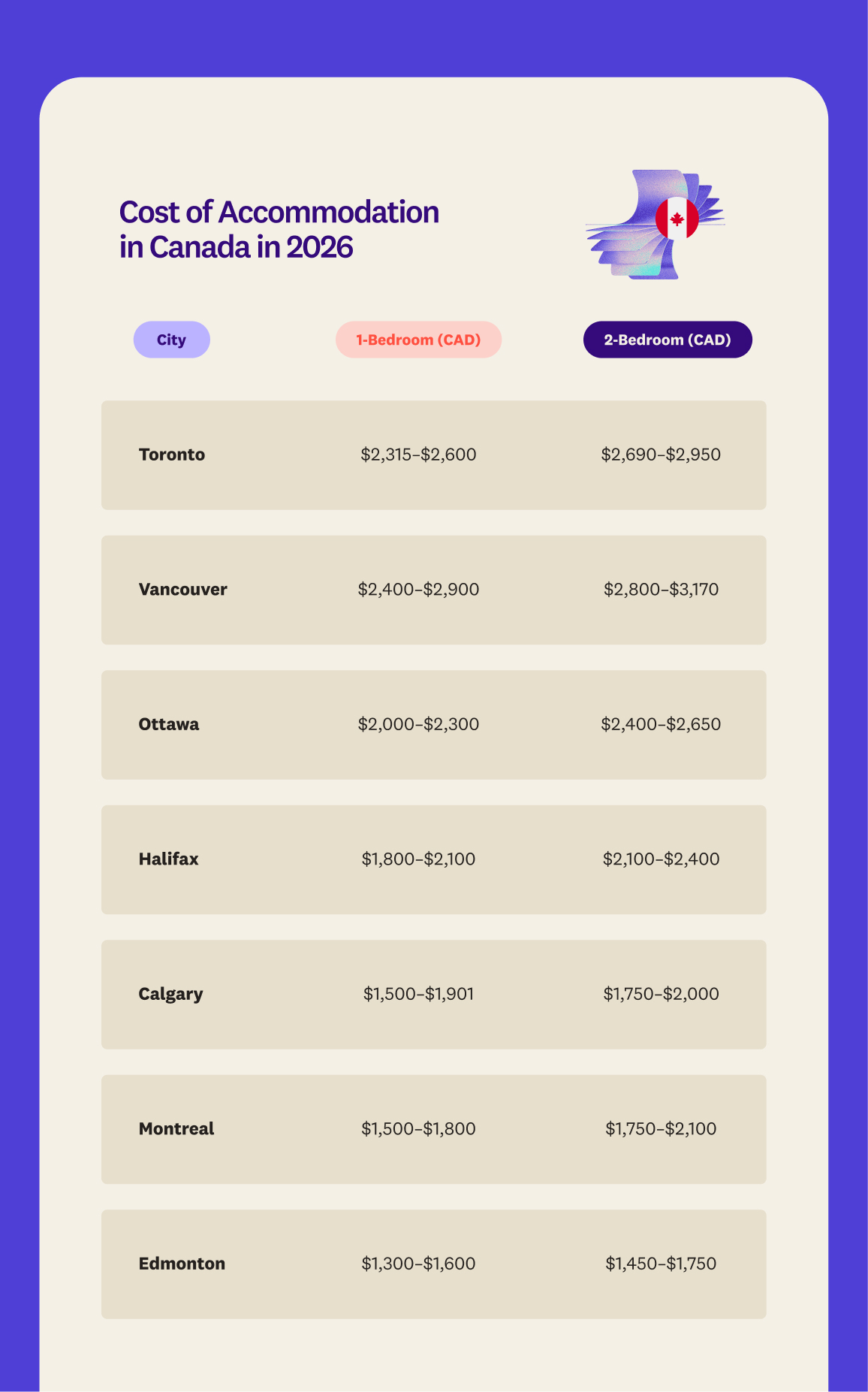
A few important things to understand about the Canadian rental market:
- Landlords typically require first and last month's rent upfront, which is effectively a two-month deposit by UK standards.
- Shared accommodation substantially reduces monthly costs and is the norm for new arrivals.
- Montreal stands out as the most affordable major city by a clear margin, partly because of Quebec's strict rent control regulations and partly because the French-first language environment reduces Anglophone demand.
- Calgary and Edmonton offer significantly more space for the money than anywhere else of comparable size, and Alberta's lack of provincial sales tax adds further financial advantage.
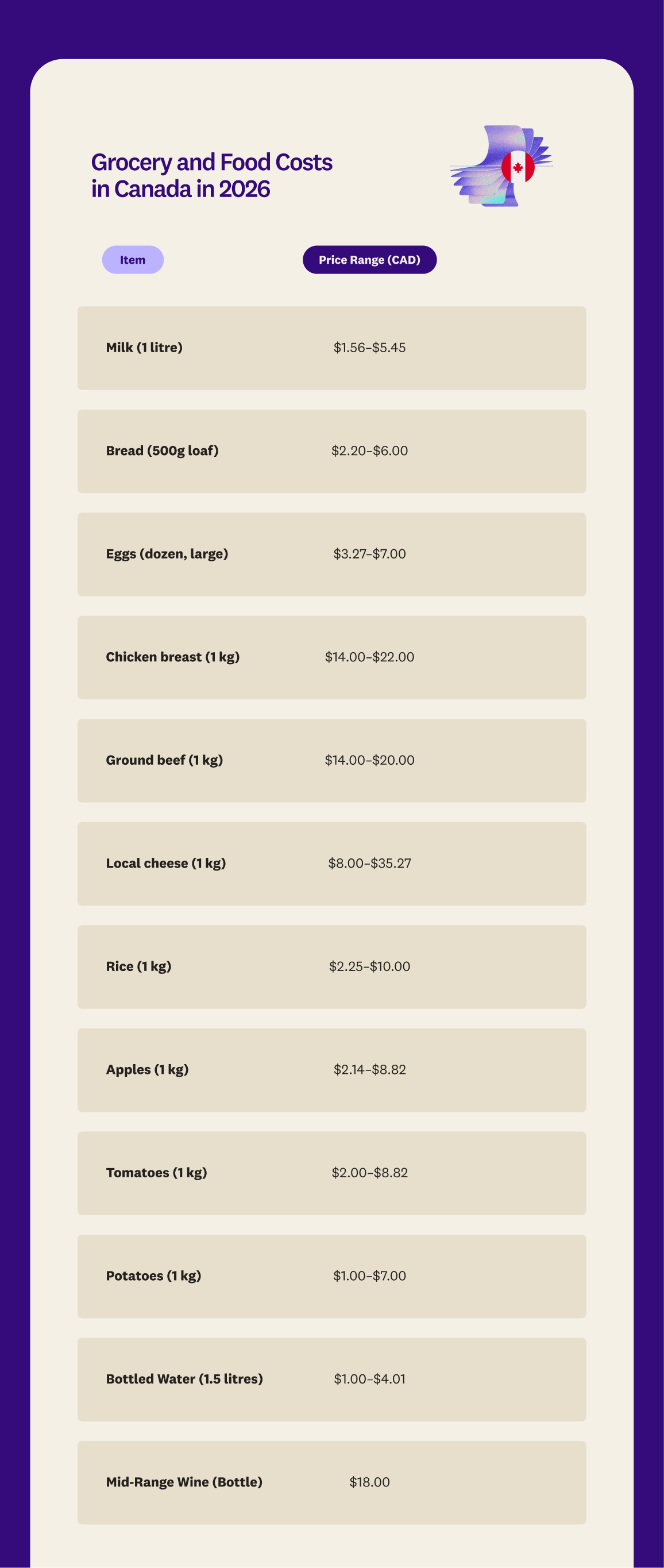
Grocery and Food Costs in Canada in 2026
Households in Canada spend approximately CAD $772 to $1,074 per month on groceries. A single person cooking mostly at home can expect to spend around $400 to $650, while a family of four should budget $1,200 to $1,500 monthly, consistent with the national family-of-four forecast of $17,571 for the full year.
Canada's grocery market is dominated by five chains, namely Loblaws, Sobeys, and Metro.
Prices vary noticeably between provinces. Fresh broccoli, for example, is often more than twice as expensive in British Columbia as in Quebec, but generally shopping at discount chains like No Frills, FreshCo, Food Basics, and Walmart Canada can result in savings of 15 to 20 per cent compared to mainstream banners.
Cost of Eating Out in Canada in 2026
Canada has a strong café culture, and eating out has been one of the fastest-rising categories in Canadian inflation.
A simple budget for an inexpensive restaurant meal is CAD $25, which most likely entails:
- Three-course meal for two (mid-range): CAD $90–$140
- Fast food combo meal: CAD $15
- Pint of domestic beer (0.5 litre): CAD $8
- Cappuccino (regular): CAD $4.50–$6.50
One important note for newcomers: Canadian restaurant bills include a 15-20% tipping expectation on top of menu prices, plus provincial sales tax.
Cost of utilities in Canada in 2026
Canadian utility costs vary significantly by province because electricity is provincially regulated and the underlying generation mix differs dramatically. Quebec, with its abundant hydroelectricity, has the cheapest electricity rates in North America at around 7.8 cents per kWh. Alberta's deregulated market sits at the other end, at 15 to 25 cents per kWh, with Ontario and British Columbia in between.
The biggest seasonal variable is heating. A one-bedroom flat in Vancouver might cost CAD $80 per month in electricity year-round, while the same flat in Calgary or Ottawa can hit $200 or more in deep winter once heating is factored in. Most older homes use natural gas for heating, which is generally cheaper than electric heat but adds to the bill.
.jpg)
Mobile and internet costs in Canada are among the highest in the OECD. That said, discount brands including Public Mobile, Fido, Koodo, and Freedom Mobile have meaningfully lowered entry-level pricing over the past two years.
Cost of Transportation in Canada in 2026
How much you spend on getting around depends enormously on where you live in Canada. Toronto, Montreal, and Vancouver have well-developed public transport networks, making it genuinely possible to live without a car. Calgary, Ottawa, and Edmonton are more car-dependent despite each having a light rail system, and most smaller cities and towns have very limited public transport.
.jpg)
Healthcare Costs in Canada in 2026
One of the most important things to understand before moving to Canada is that your eligibility for public healthcare depends entirely on which province you settle in and what your immigration status is.
Each province runs its own publicly funded healthcare plan: OHIP in Ontario, MSP in British Columbia, RAMQ in Quebec, and AHCIP in Alberta. These plans cover most medically necessary services, including GP visits, specialist consultations, and hospital stays. Still, they typically do not cover prescription medication outside the hospital, dental care, optometry, or physiotherapy.
Cost of Education in Canada in 2026
In higher education, Canada ranks third globally in terms of public university tuition, with average annual undergraduate fees of around $5,590 for domestic students.
State schools in Canada are free for citizens and permanent residents. However, international arrivals must pay between CAD $9,000 and $17,000 per year for state schooling, with private day schools ranging from CAD $15,000 to $30,000 annually.
🔗ICYMI: We wrote a blog on how to find work opportunities as an International student.
How Much Does It Cost to Live Comfortably in Canada in 2026?
With all the information provided, here’s how total monthly costs compare for a single person renting a one-bedroom flat across Canada's four main cities in 2026.
Although it’s important to bear in mind that Toronto and Vancouver are in a league of their own when it comes to cost, driven primarily by housing. Calgary offers a noticeable advantage across rent, groceries, and taxes, given that Alberta has no provincial sales tax.
Montreal is the most affordable major city by a clear margin, helped by rent control, low electricity costs, Quebec's heavily subsidised transit, and the CWELCC childcare programme. The trade-off is that workplace French is widely expected outside specific industries.
Practical Tips for Managing the Cost of Living in Canada
Groceries: Shop at discount chains. No Frills, FreshCo, Food Basics, and Walmart Canada are consistently 15 to 20 per cent cheaper than mainstream banners. Buy seasonally, opt for frozen rather than fresh where possible (especially berries and vegetables), and batch cook to reduce food waste.
Housing: Look beyond Toronto and Vancouver. Calgary, Montreal, Edmonton, and Halifax offer substantially lower rents without sacrificing urban amenities. In provinces with rent control, such as Quebec, renewing a lease in place is far cheaper than moving to a new flat.
Transport: If you live in a transit-served city, seriously consider whether you actually need a car. Monthly pass costs are a fraction of car ownership, even at Toronto's relatively expensive $156 per month.
Managing Your Money in Canada as a Newcomer
Moving to Canada comes with a lot of moving parts, and your finances should not be the most stressful one.
You may need to put a deposit down on your new flat, set up broadband, buy groceries, and pay your first month of bills, all before you have had a chance to settle in fully.
Instead of juggling multiple banking apps and losing money to hidden exchange-rate markups, Raenest lets you manage your global finances from one place. You can now send CAD directly to Canadian bank accounts through Raenest, which means paying tuition fees, settling your first month's rent, or covering a security deposit becomes straightforward from day one.
With Raenest, you get access to multi-currency accounts, allowing you to hold, receive, and send money in USD, GBP and EUR alongside your home currency. You also get access to virtual cards that make paying for your morning coffee, monthly transit pass, or grocery run a breeze, with zero foreign transaction headaches.
Don’t let currency conversions and banking delays slow down your new life in Canada. Sign up for Raenest today and take control of your money, no matter where you call home.
Frequently Asked Questions About the Cost of Living in Canada
- What is the cheapest province to live in Canada in 2026?
New Brunswick is consistently the most affordable province overall, with monthly costs for a single person ranging from $2,300 to $2,700. Saskatchewan and Manitoba are close behind.
- How much money do you need to live comfortably in Canada?
A single professional needs roughly $3,300 to $4,500 per month, depending on the city. A family of four should budget between $5,900 and $7,900 per month, including rent.
- Is Canada more expensive than the UK?
On average, yes. Canada ranks higher than the UK on the 2026 Numbeo Cost of Living Index. Housing in particular is more expensive in major Canadian cities than in most UK cities outside London. You can read our full UK cost-of-living guide for 2026 for a detailed comparison.
- What salary do you need to live comfortably in Canada?
Most financial advisers suggest earning at least CAD $55,000 to $65,000 per year as a single person in a major city, or CAD $90,000 or more for a family of four, to live comfortably without financial strain.