
How to receive international payment in the Philippines 2026

For years, Filipinos receiving international payments have had to choose between three imperfect options. Online payment platforms like PayPal, Payoneer, and Wise made cross-border payments accessible, but often at the cost of forced currency conversion, withdrawal delays, and fees that are hard to track until after the money is gone. Traditional bank transfers offered familiarity, but not speed or transparency. More recently, some clients have started paying with stablecoins like USDT or USDC, which solves speed but introduces a whole new layer of complexity when it’s time to actually use the money.
What most people really want is simple: get paid in the same currency their client sends, hold it if they want, and move it to pesos only when it makes sense. That’s where global accounts and modern digital financial platforms come in.
Today, we’ll be learning how you can receive international payments in the Philippines at competitive rates, seamlessly and fast. If you’re a freelancer, remote worker, online seller, creator, and business owner in the Philippines who receives payments from overseas clients—whether in USD, GBP, EUR, or even stablecoins, this is for you.
Common ways to receive International Payments in the Philippines
There’s no single “official” way Filipinos receive money from abroad. What exists instead is a mix of systems built at different times, for different types of users, and with very different trade-offs. Some are familiar and widely accepted. Others are newer and designed for people earning globally but spending locally.
Understanding how each option works—and where it tends to fall short—makes it much easier to choose what actually fits how you get paid.
- International Bank Transfers (SWIFT)
This is the traditional route. Your client sends money directly from their bank to your Philippine bank account using the SWIFT network.
It’s reliable in the sense that banks trust it and businesses understand it. But it’s also the most rigid option. You’ll need to share your bank’s SWIFT code, your account number, and sometimes additional intermediary details. Transfers can take several business days, and fees are usually deducted along the way rather than shown upfront. By the time the money reaches you, it’s often already been converted to pesos at a rate you didn’t choose.
SWIFT transfers tend to work best for large, infrequent payments or formal business transactions. For regular freelance or remote work income, they can feel slow and expensive.
- Online Payment Platforms
Online platforms became popular because they removed friction. You didn’t need to understand bank codes or international wiring rules. You just signed up, shared an email or payment link, and got paid.
For Filipinos, platforms like PayPal, Payoneer, and Wise are still widely used, especially with international clients who already prefer them. The trade-off is control. Most platforms automatically convert your funds to PHP when you withdraw, often at exchange rates that can be unfavourable. Fees can come from multiple places—receiving, converting, and withdrawing—and aren’t always obvious until after the transaction is complete. These platforms are convenient, but over time, frequent earners start to notice how much value is lost in small cuts.
- Stablecoins and Digital Assets
Some international clients—especially in tech, crypto, and global startups—now pay using stablecoins like USDT or USDC.
Stablecoins move fast and avoid traditional banking delays, but they’re not automatically useful on their own. You still need a safe, compliant way to receive them and convert them into spendable money in the Philippines. For people comfortable with digital assets, this can be an efficient option. For others, it can feel like one more system to manage. This is where platforms like Raenest that support both traditional currencies and stablecoins in one place start to matter.
Best way to receive International Payments in the Philippines
In 2026, the most reliable way to receive international payments in the Philippines is through a platform that gives you direct access to global currencies, clear fees, and a structure that actually understands how cross-border income works. That’s exactly what Raenest is built for. With Raenest, you can:
- Open multi-currency accounts in USD, GBP, and EUR.
- Receive international payments, including salaries, freelance payments (from popular platforms like Upwork and Fiverr), transfers from clients and loved ones, and payouts from global platforms.
- Get your Upwork payments in under 60 minutes with Raenest FastTrack.
- Receive USDT and USDC, automatically converted to USD with the same value and no delays.
- Convert to PHP any time at competitive rates and withdraw to your Indian bank account.
- Send money worldwide.
- Enjoy better rates, fast transfers, low fees, and two free monthly deposits.
For freelancers, remote workers, creators, and businesses earning consistently from abroad, this kind of setup removes guesswork. You get paid in the currency you earn, move money on your terms, and stop juggling multiple apps just to make your income usable.
How to receive international payments in the Philippines with Raenest
.jpg)
Getting started with Raenest is simple, and the process is designed to get you ready to receive international payments quickly. Here’s how it works:
Step 1: Download the Raenest App
Start by downloading the Raenest app from the App Store or Google Play Store. This is where you’ll manage your international payments and accounts.
Step 2: Register and secure your account
- Select your country of residence
- Enter your email address and verify it.
- Create a secure password to protect your account.
- As part of legal requirements, you’ll confirm that your account information aligns with the US Patriot Act regulations and tap continue.
Step 3: Choose what you want to do with Raenest
Raenest lets you set things up based on your immediate needs. You can choose to:
- Open bank accounts in USD, GBP or EUR.
- Receive stablecoins (USDC and USDT).
- Send money abroad.
Step 4: Verify your Identity (KYC)
To fully activate your account, you’ll need to complete identity verification. From your dashboard, tap Verify Now and provide the required details. This step ensures your account is compliant and ready for international transactions.
Step 5: Start using your account
Once your verification is approved, you can start using Raenest right away. You’ll be able to:
- Access your multi-currency bank account details to receive payments from international clients.
- Receive international payments in USDT or USDC.
- Send money to over 70 countries, as well as your local bank account, when needed.
- Manage your global payments from one dashboard.
With your Raenest account ready, getting paid from abroad is easy and stress-free. Create a Raenest account today and start receiving your money smoothly.
Frequently Asked Questions (FAQs)
1. Is it legal to receive international payments in the Philippines?
Yes. It’s completely legal to receive money from overseas clients, platforms, or loved ones. Just make sure the funds are properly documented, and for business or freelance income, you comply with local tax rules.
2. Do I need a USD, GBP, or EUR account to receive foreign payments?
Yes. To receive payments in foreign currencies, you need to open a corresponding currency account, and the multi-currency accounts Raenest offers you accounts in USD, GBP, EUR and stablecoin wallets for USDC and USDT.
3. Can I receive PayPal, Payoneer, and Wise payments in the Philippines?
Yes. All three platforms operate in the Philippines. PayPal is widely used, Wise offers transparent mid-market rates, and Payoneer provides local receiving account options. Each has different fees and withdrawal timelines.
4. How long do international payments take to arrive in the Philippines?
It depends on the method:
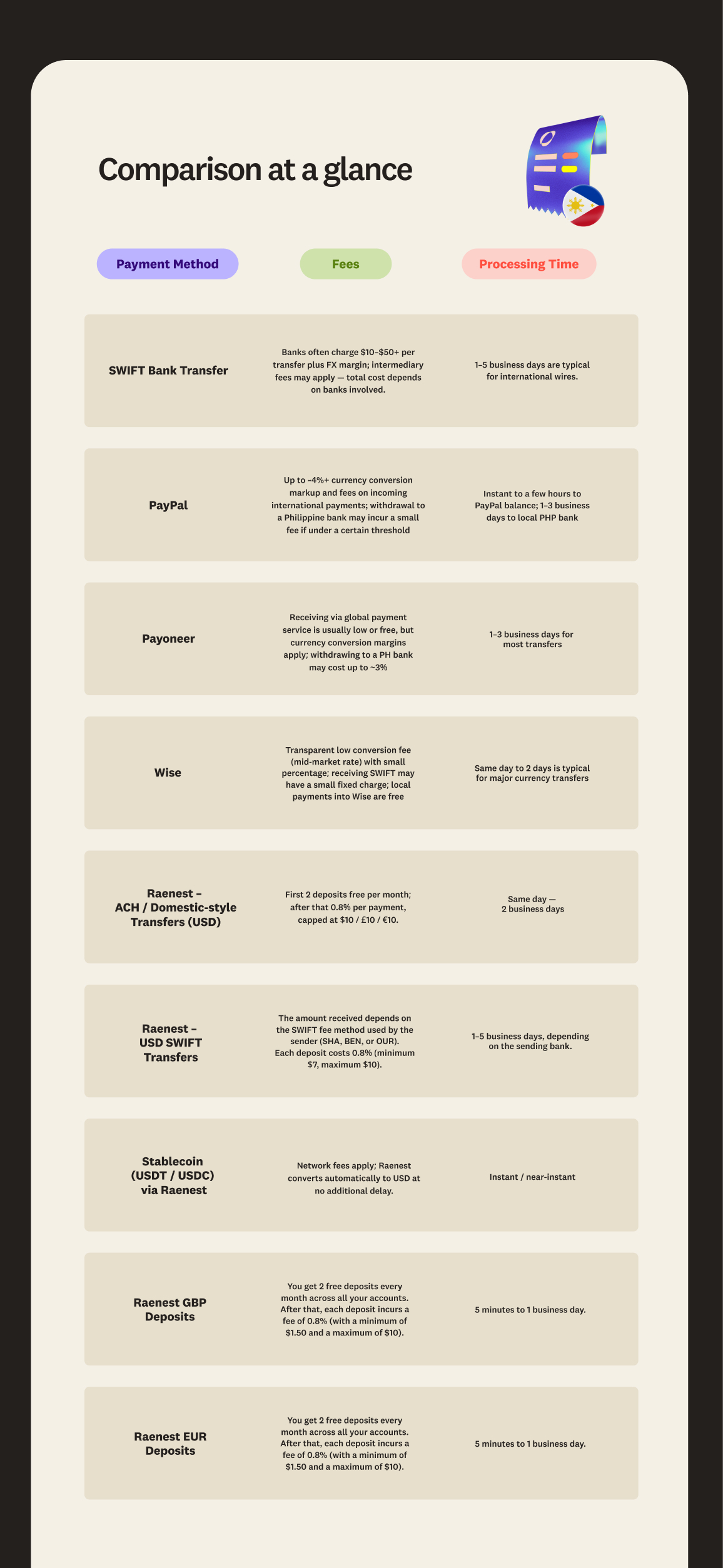
- SWIFT bank transfers: 1–5 business days
- PayPal: instant to a few hours in your account, 1–3 days to a local bank
- Payoneer: 1–3 business days
- Wise: same day to 2 business days
- Raenest: instant to 2 business days (stablecoins are near-instant)
5. Are international payments taxable in the Philippines?
Yes, foreign income is generally taxable and must be reported to the BIR. The amount and type of tax depend on whether you’re a freelancer, employee, or business. Always consult a tax professional for guidance.
6. Can I receive cryptocurrency payments in the Philippines?
Yes, stablecoins like USDT and USDC can be received through platforms like Raenest. These are automatically converted to USD with no delay, making it simple to use for local spending or withdrawals.
7. What details do I need to give a client to receive international payments?
- For traditional bank transfers: your account number, SWIFT/BIC, and bank details.
- For multi-currency accounts like Raenest: the account details in USD, GBP, or EUR.
- For stablecoins: your USDT/USDC wallet address.
8. Which is the cheapest way to receive international payments in the Philippines?
Using platforms with transparent fees and mid-market rates—like Raenest—usually results in lower costs compared to PayPal or traditional SWIFT transfers, especially for recurring payments.
9. Can I receive payments from global freelancing platforms like Upwork or Fiverr?
Yes. Raenest supports payouts from Upwork, Fiverr, and other platforms. Some payments can arrive in under 60 minutes using features like Raenest FastTrack.
10. How can I withdraw foreign currency payments to my Philippine bank account?
Most platforms allow you to convert foreign currencies to PHP and withdraw to a local bank. With Raenest, you control when to convert, helping you get the best rates and avoid forced conversions.
.jpg)

